
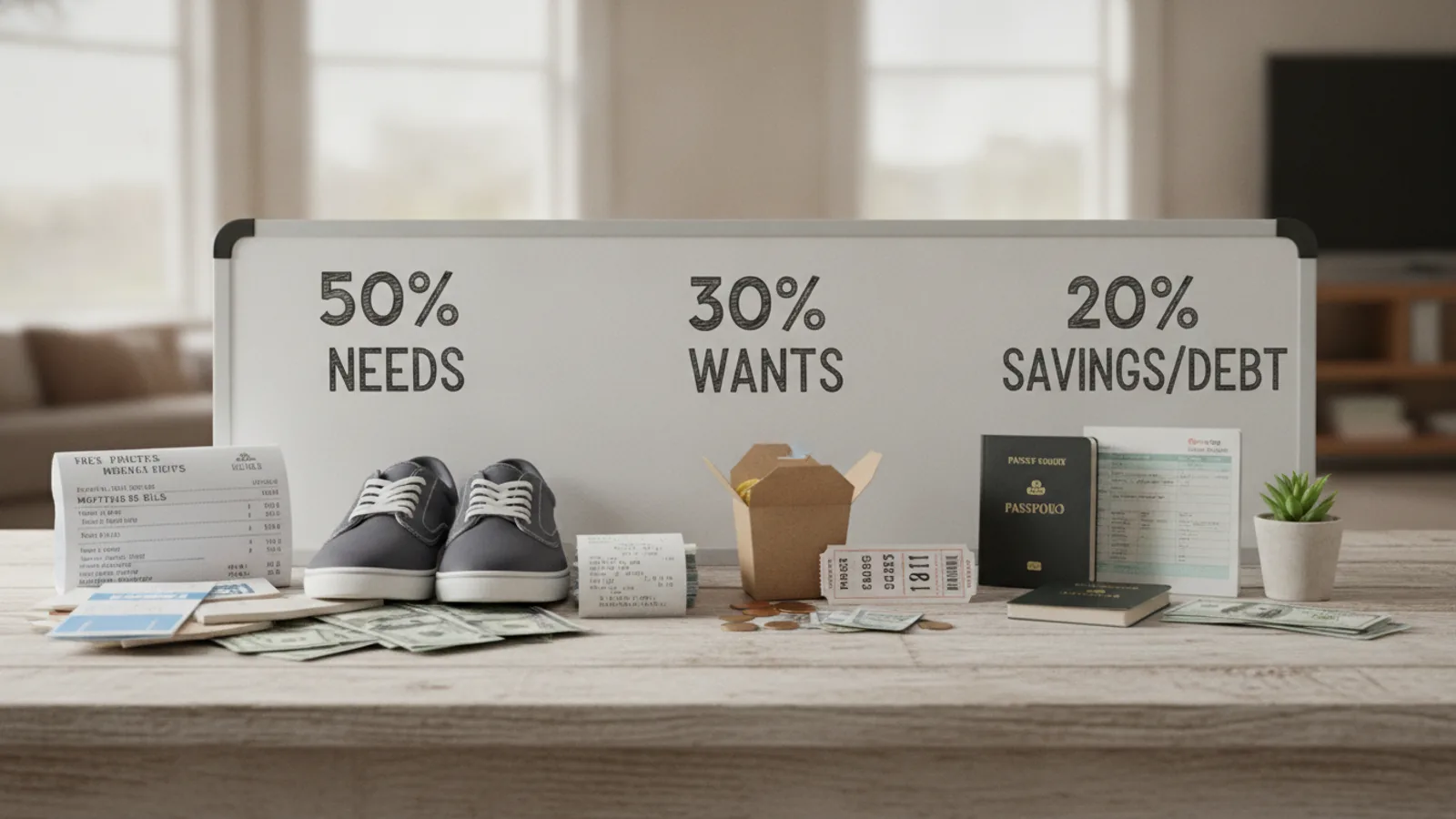
50 30 20 Budget Rule Explained
The 50/30/20 budget rule is a simple, powerful way to manage your money without complicated spreadsheets or tracking every single penny. It divides your after-tax income into three categories: 50% for Needs, 30% for Wants, and 20% for Savings and Debt Repayment. This guide helps you understand the rule, calculate your personal spending targets, and apply it to your financial life. It's perfect for anyone who feels overwhelmed by budgeting and wants a straightforward framework to gain control over their finances and start working toward their goals.
Fast Answer
- Core Principle: 50% for Needs, 30% for Wants, 20% for Savings.
- Calculation Basis: Your monthly after-tax (net) income.
- Best For: Beginners seeking a simple, flexible budgeting guideline.
Before You Start
Before you can apply the 50/30/20 rule, you need a clear picture of your current financial situation. Gathering these documents will make the process much smoother and more accurate. This isn't about judging your past spending; it's about creating a clear baseline to build your new budget from.
- Your last 1-3 months of pay stubs: This helps you find your consistent after-tax income. If your income varies, using an average of three months is a good strategy.
- Your last 1-3 months of bank statements: These show exactly where your money has been going, including cash withdrawals and debit card purchases.
- Your last 1-3 months of credit card statements: This is crucial for tracking spending, especially in the "Wants" category.
- A calculator: For figuring out your percentages.
- A notebook, spreadsheet, or budgeting app: Choose whatever tool you feel most comfortable with to list and categorize your expenses.
Step-by-Step Instructions
Step 1: Calculate Your Monthly After-Tax Income
Your after-tax income is the foundation of your entire budget. This is the amount of money that actually hits your bank account each payday after all deductions are taken out. Look at your pay stub for the line item that says "Net Pay" or "Take-Home Pay." This is the number you'll use.
Deductions typically include federal and state taxes, Social Security, Medicare, health insurance premiums, and pre-tax retirement contributions like a 401(k). If you get paid weekly or bi-weekly, you'll need to convert this to a monthly figure. For bi-weekly pay, multiply your net pay by 26 (paychecks per year) and then divide by 12 (months). For weekly pay, multiply by 52 and divide by 12.
If your income is irregular (you're a freelancer or work on commission), look at your income over the last three to six months and calculate a conservative monthly average. It's often safer to budget based on your lowest-earning month to ensure your core needs are always covered.
Step 2: Determine Your 50/30/20 Spending Targets
Now that you have your monthly after-tax income number, you can calculate your budget targets. This is a simple math exercise. Multiply your monthly net income by 0.50, 0.30, and 0.20 to find the maximum amount you should be spending in each category.
Let's use an example. If your monthly after-tax income is $4,000:
- Needs (50%): $4,000 x 0.50 = $2,000
- Wants (30%): $4,000 x 0.30 = $1,200
- Savings (20%): $4,000 x 0.20 = $800
Write these three numbers down. These are your goals. The next steps will involve figuring out how your current spending compares to these targets.
Step 3: List and Categorize Your 'Needs' (50%)
The "Needs" category covers all your essential survival expenses. These are the bills you absolutely must pay each month. If you stopped paying them, there would be immediate and severe consequences. The goal is to keep the total cost of these items at or below 50% of your take-home pay.
Go through your bank and credit card statements and list all expenses that fall into this category. Common examples include:
- Housing: Rent or mortgage payment.
- Utilities: Electricity, water, natural gas, internet (if required for work).
- Transportation: Car payment, gas, car insurance, public transit passes needed to get to work.
- Groceries: Basic food for cooking at home.
- Insurance: Health, renters, or homeowners insurance.
- Minimum Debt Payments: The required minimum payment on student loans, credit cards, or personal loans.
- Childcare: Necessary costs for you to be able to work.
Step 4: List and Categorize Your 'Wants' (30%)
"Wants" are all the non-essential things you spend money on that make life more enjoyable and entertaining. This category is where your discretionary spending lives. It's often the most flexible part of your budget and the easiest area to make cuts if you need to free up money for other categories.
Review your statements again for these types of expenses:
- Entertainment: Streaming services (Netflix, Spotify), movie tickets, concerts, video games.
- Dining Out: Restaurants, coffee shops, takeout, food delivery services.
- Hobbies: Gym memberships, art supplies, sports equipment.
- Shopping: New clothes, electronics, home decor, and other non-essential items.
- Travel: Vacations, weekend trips, flights.
- Upgraded Services: A more expensive phone plan than you need, premium cable packages.
This category isn't "bad." It's a planned part of your budget. The 50/30/20 rule acknowledges that having fun is important; it just puts a reasonable ceiling on it to ensure you're also saving for the future.
Step 5: Calculate Your 'Savings & Debt Repayment' (20%)
This is the most important category for your future financial health. The 20% target is for money you put toward savings goals and paying down debt above the minimum payments. This is how you build wealth and financial security.
Your 20% can be allocated to a mix of goals, including:
- Emergency Fund: Saving 3-6 months of essential living expenses in a high-yield savings account.
- Retirement Savings: Contributions to a Roth IRA or other retirement accounts.
- Extra Debt Payments: Paying more than the minimum on high-interest debt like credit cards or personal loans. This is a form of saving, as it saves you money on future interest payments.
- Sinking Funds: Saving for large, specific goals like a down payment on a house, a new car, or a wedding.
Add up any automatic savings transfers and extra debt payments you're already making. This will show you your current savings rate. The goal is to get this number to at least 20% of your take-home pay.
Step 6: Track Your Spending and Compare to Your Targets
With your expenses listed and categorized, it's time for the moment of truth. Add up the totals for each of the three categories: Needs, Wants, and Savings. Now, compare your actual spending to the targets you calculated in Step 2.
For our example person with a $4,000 monthly income:
- Target: $2,000 Needs / $1,200 Wants / $800 Savings
- Actual Spending (Example): $2,400 Needs / $1,400 Wants / $200 Savings
In this example, the "Needs" are over by $400, "Wants" are over by $200, and "Savings" is underfunded by $600. This is a very common result when people first budget. Seeing these numbers clearly is the first step to making positive changes.
Step 7: Adjust Your Spending to Align with the Rule
If your numbers are out of balance, the next step is to make a plan to adjust. The goal is to shift money from over-funded categories to under-funded ones. Start with the easiest changes first.
- Reduce Wants: This is usually the lowest-hanging fruit. Can you cancel a streaming service you don't use? Cook at home one more night a week instead of ordering takeout? Pause your clothing shopping for a month? Small changes in the "Wants" category can add up quickly and help you redirect money toward your savings goals.
- Reduce Needs: This is more difficult but can have a huge impact. Look at your biggest "Needs" expenses. Can you find a cheaper car insurance rate by shopping around? Can you lower your electricity bill with more efficient habits? Can you reduce your grocery bill by meal planning and avoiding brand names? Long-term, you might consider larger changes like getting a roommate or moving to a lower-cost area.
- Increase Savings: The best way to hit your 20% target is to make it automatic. Set up an automatic transfer from your checking account to your savings account for the day after you get paid. This "pay yourself first" method ensures your savings goal is met before you have a chance to spend the money on wants.
Quick Reference
Categorizing expenses can be tricky. Use this table as a cheat sheet for common situations that cause confusion.
| Situation | Use this Category | Why |
|---|---|---|
| My student loan minimum payment | Needs (50%) | This is a required, contractual payment you must make to avoid default. |
| Extra payment on my credit card | Savings & Debt (20%) | You're paying more than the minimum to reduce principal and save on interest, which is a powerful financial move. |
| My Netflix subscription | Wants (30%) | It's a form of entertainment, not an essential for living and working. |
| Groceries from a specialty store | Split (Need/Want) | The cost of basic ingredients is a Need. The premium for organic, gourmet, or pre-made items is a Want. |
| My car payment | Needs (50%) | Assuming the car is necessary for you to get to work and manage your life, the payment is a need. |
| A new smartphone | Wants (30%) | While a basic phone service might be a need, the latest expensive model is a luxury purchase. |
Common Problems When You 50 30 20 budget rule explained
Problem: My 'Needs' take up way more than 50% of my income.
This is an incredibly common issue, especially for those living in high-cost-of-living areas or on a tighter income. If your housing, transportation, and groceries alone eat up 60-70% of your pay, don't panic or give up on budgeting.
Solution: View the 50/30/20 rule as a guideline, not a strict law. Your budget might temporarily look more like 65/15/20 or 70/10/20. The key is that you are still intentionally assigning your money. The rule has highlighted a core problem: your essential expenses are too high for your income. Your focus should be on either increasing your income (side hustle, ask for a raise) or finding ways to reduce one of the "big three" expenses: housing (roommate, move), transportation (cheaper car, public transit), or food (strict meal planning).
Problem: It's too hard to classify everything as a 'Need' or a 'Want'.
The line between a need and a want can feel blurry. Is a gym membership for your mental health a need or a want? What about your daily coffee that helps you get through the workday?
Solution: The "survive vs. thrive" test. Ask yourself: "Could I survive without this?" If the honest answer is yes, it's a want. You can survive without a gym membership by exercising at home or outside. You can survive without a coffee shop by making coffee at home. This doesn't mean you have to give them up! It just means they belong in the 30% "Wants" category, which is specifically designed for things that help you thrive. The goal is honesty, not deprivation.
Problem: My income changes every month.
Budgeting with a variable income from freelancing, commissions, or irregular hours feels impossible with a fixed-percentage rule.
Solution: Budget based on your baseline. Look at your income over the past six months and find your lowest monthly take-home pay. Build your 50/30/20 budget based on that conservative number. This ensures your essential needs are always covered. In months where you earn more than your baseline, that "extra" income should go directly toward your 20% category. Use it to supercharge your emergency fund, pay off a huge chunk of debt, or boost your retirement savings. This method turns your variable income into a powerful wealth-building tool.
Advanced Tips for 50 30 20 budget rule explained
Once you've mastered the basics, you can use these strategies to make the 50/30/20 rule even more effective.
Automate Your Savings ("Pay Yourself First")
The single most powerful budgeting hack is to make your savings automatic. Don't wait until the end of the month to see what's "left over" for savings. Instead, set up an automatic, recurring transfer from your checking account to your savings or investment account. Schedule it for the day you get paid. This way, your 20% savings goal is met before you can be tempted to spend it. You are treating your savings like any other important bill.
Use Sinking Funds for Big Purchases
A "sinking fund" is a dedicated savings account for a specific, predictable future expense. Instead of letting a big purchase like holiday gifts, a vacation, or annual car insurance premiums wreck your monthly budget, you save for it gradually. For example, if you want to spend $1,200 on a vacation in a year, you would create a sinking fund and automatically transfer $100 per month into it from your 30% "Wants" category. When it's time to book the trip, the money is already there, and your budget remains stable.
Try the "Reverse" Budget Method
If you find tracking every expense tedious, the reverse budget might be for you. In this approach, you focus only on your 20% savings goal. As long as you successfully automate saving 20% of your after-tax income each month, you give yourself permission to spend the remaining 80% however you see fit. This method works well for people who are naturally good at keeping their "Needs" in check and don't overspend on "Wants." It prioritizes the most important goal (saving) while reducing the administrative work of detailed tracking.
Adjust the Ratios for Your Financial Goals
The 50/30/20 rule is a starting point, not a permanent destination. As your life and goals change, you should adjust the ratios. If you're focused on getting out of high-interest credit card debt, you might adopt an aggressive 50/10/40 budget, slashing your "Wants" to a bare minimum to put 40% of your income toward debt. Conversely, if you're debt-free with a fully funded emergency fund, you might relax into a 50/35/15 budget, allowing for more lifestyle spending while still saving a healthy amount for retirement.
50 30 20 Budget Rule Explained FAQ
Who first created the 50/30/20 budget rule?
The rule was popularized by U.S. Senator Elizabeth Warren and her daughter, Amelia Warren Tyagi, in their book, "All Your Worth: The Ultimate Lifetime Money Plan." They developed it as a simple, straightforward way for American families to gain financial stability.
Does the rule apply to gross (pre-tax) or net (after-tax) income?
It is always based on net (after-tax) income. This is the actual amount of money you have available to spend and save, making it the only realistic number to use for a budget.
How does this rule work for couples or families?
It works very well. The couple or family would first combine their total monthly after-tax incomes. Then, they would apply the 50/30/20 percentages to that combined total to create a household budget. The process of categorizing needs, wants, and savings remains the same, though the specific expenses will reflect the needs of the entire family (e.g., childcare, larger grocery bills).
What if I'm self-employed?
If you are self-employed, you first need to pay yourself a consistent salary. After accounting for business expenses and setting aside money for taxes (a critical step for freelancers), the amount you pay yourself is your "after-tax" income. You would then apply the 50/30/20 rule to that personal salary.
Is the 50/30/20 rule the best way to budget?
The "best" budgeting method is the one you can consistently stick with. The 50/30/20 rule is fantastic for its simplicity and flexibility, making it an ideal starting point for most people. Other popular methods, like zero-based budgeting (where every dollar is assigned a job) or the envelope system, are more granular and may appeal to different personality types. Try the 50/30/20 rule first; if it works, stick with it. If not, explore other options.
Final Checklist for 50 30 20 budget rule explained
Use this checklist to ensure you've completed all the necessary steps to successfully implement your new budget.
- Calculated your correct monthly after-tax (net) income.
- Determined your specific dollar-amount targets for 50% (Needs), 30% (Wants), and 20% (Savings).
- Listed all your monthly expenses from the last 1-2 months.
- Categorized each expense as a Need, a Want, or a Savings/Debt Repayment.
- Added up the totals for each category and compared your actual spending to your targets.
- Identified at least one or two specific areas where you can adjust your spending to better align with the rule.
- Chosen a system to track your spending going forward (whether it's an app, a spreadsheet, or a notebook).
- Scheduled an automatic transfer to your savings account to meet your 20% goal.