
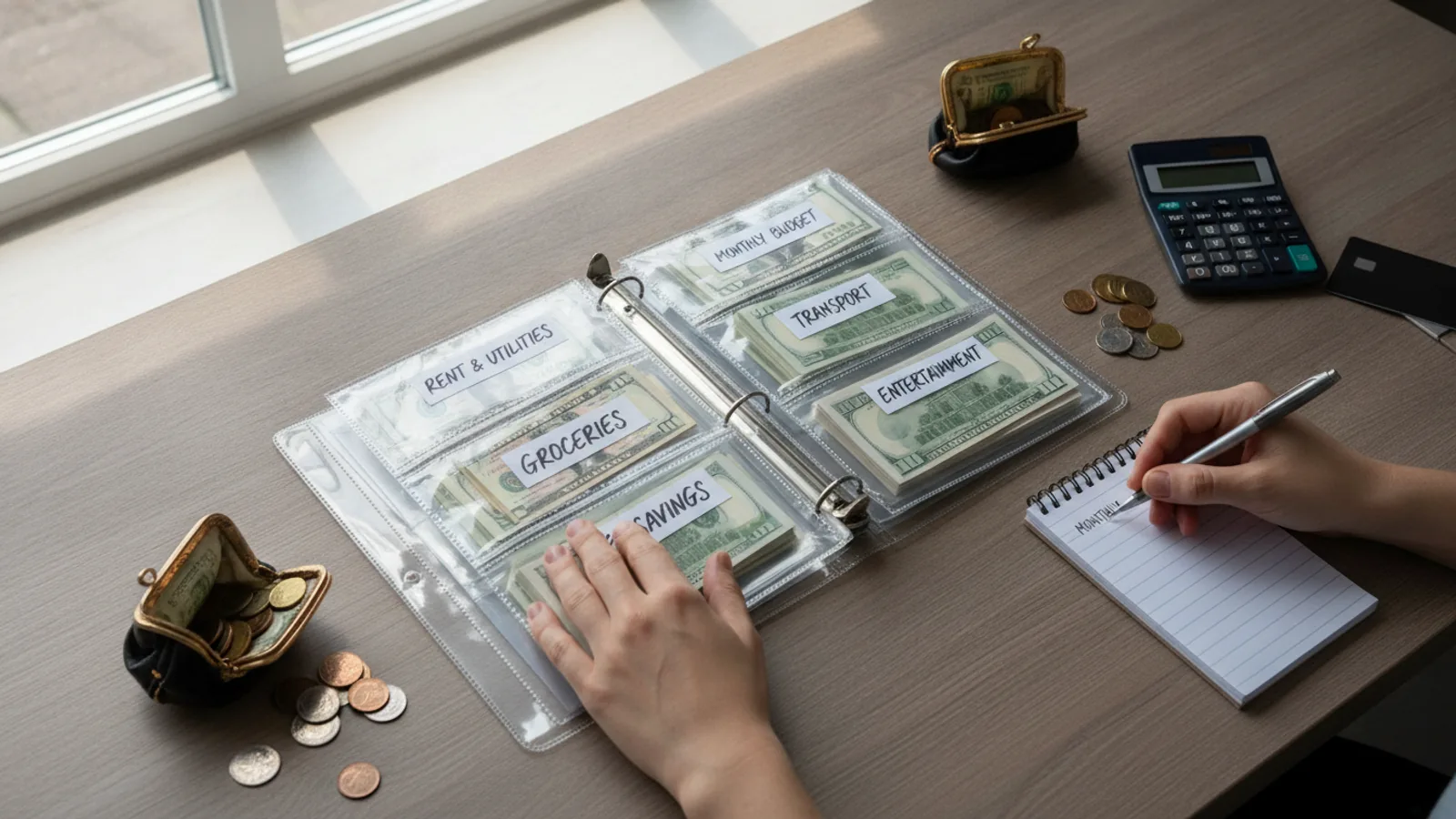
Cash Stuffing Budgeting Method
The cash stuffing budgeting method is a hands-on system for managing your money that helps you visually track and control your spending. By using physical cash allocated into labeled envelopes for different expense categories, you can prevent overspending on debit and credit cards. This guide is perfect if you're a visual learner, new to budgeting, or find yourself constantly going over budget with digital payments. It turns abstract numbers in a bank account into a tangible resource you can see and feel, putting you back in control of your financial habits.
Fast Answer
- The method: Allocate physical cash into labeled envelopes for specific spending categories like groceries, gas, and entertainment.
- The goal: To stop spending in a category once the cash in its envelope is gone, preventing debt and overspending.
- Best for: Anyone who struggles with impulse buys or finds it hard to track spending with credit or debit cards.
Before You Start
Success with cash stuffing starts with a little preparation. You can't decide where your money should go until you know where it's currently going. Gathering a few simple tools and understanding your own spending habits are the most important first steps. This initial work will make the entire process smoother and more effective.
- A Clear Financial Picture: You'll need to know your total monthly take-home income and have a general idea of your expenses. If you're unsure, spend a week or two tracking every dollar you spend.
- Budgeting Categories: Make a list of your variable expenses—the ones that change each month. Common categories include groceries, transportation (gas/bus fare), dining out, entertainment, personal care, and household supplies.
- Physical Envelopes: You can use standard paper envelopes, zippered A6 binder pouches, or any small container you can label. You don't need to buy a fancy system to start.
- Cash: You will need to be able to withdraw cash from your bank account based on your budget. It helps to get smaller bills ($5s, $10s, $20s) to make distribution easier.
- A Safe Storage Spot: Decide on a secure place in your home to keep your envelopes. A small lockbox, a fireproof bag, or a hidden drawer are good options.
Step-by-Step Instructions
Follow these steps to set up and maintain your cash stuffing system. The key is consistency. At first, it might feel like extra work, but it quickly becomes a simple routine that provides a powerful sense of control over your finances.
Analyze Your Income and Expenses
Before you can stuff any envelopes, you need a clear budget. Start by calculating your total monthly income after taxes. Next, track your spending for a full month to see exactly where your money is going. You can use a notebook, a spreadsheet, or a budgeting app. Be honest and thorough—include every coffee, subscription, and impulse purchase.
Once you have a month of data, categorize your expenses. Divide them into two main groups: fixed expenses (costs that are the same every month, like rent, mortgage, car payments, and insurance) and variable expenses (costs that change, like groceries, gas, entertainment, and shopping). The cash stuffing method is designed primarily for your variable expenses.
Create Your Budget and Assign Spending Limits
Now, create your monthly budget. Start with your total take-home pay at the top. Subtract your fixed expenses first, as these are non-negotiable. Then, subtract any savings goals or debt payments you have. The amount remaining is what you have available for all your variable spending categories.
Assign a spending limit to each of your variable categories based on your past spending data and your financial goals. Be realistic. If you spent $700 on groceries last month, budgeting only $300 is setting yourself up for failure. Aim for small, gradual reductions you can stick with. The total of all your budgeted variable expenses should not exceed the money you have left after paying fixed bills and saving.
Withdraw Your Cash from the Bank
On payday, calculate the total amount of cash needed for all your variable expense envelopes for that pay period (whether it's for the week, two weeks, or the full month). Go to your bank or an ATM and withdraw that specific amount of cash.
This step is a crucial mental trigger. Physically holding the money you have to live on for the month makes its value feel more real than seeing numbers on a screen.
Label and "Stuff" Your Envelopes
Take your envelopes and a marker. Write the name of one variable spending category on each envelope (e.g., "Groceries," "Gas," "Pets," "Fun Money," "Date Night"). You can be as broad or as specific as you like.
Next, take your pile of cash and carefully count out the amount you budgeted for each category. Place the money inside its corresponding labeled envelope. This process is often called a "cash stuffing" or "stuffing" ceremony. Once all the cash is allocated, you have successfully set your budget for the period.
Spend Only from Your Designated Envelopes
This is where the system's power comes into play. Throughout the month, when you need to make a purchase, you must use the cash from the correct envelope. If you're going to the supermarket, take your "Groceries" envelope with you. When you fill up your car, use the cash from your "Gas" envelope.
The most important rule is to leave your credit and debit cards at home to avoid the temptation of overspending. When the cash in an envelope is gone, your spending in that category must stop until the next payday. This creates a hard limit that digital payments don't offer.
Track Your Spending and Handle Leftovers
Even though you're using cash, it's a good idea to keep track of your purchases. You can write transactions on the outside of the envelope or keep receipts inside. This helps you see where your money went within a category and makes it easier to adjust your budget later.
At the end of the budgeting period, you may have leftover money in some envelopes. This is a win! You have to decide what to do with it. You can roll it over to the next month's envelope for that category, put it toward a debt payment, or move it into a savings envelope for a specific goal like a vacation or emergency fund. Rewarding yourself by allocating leftovers to a goal reinforces positive spending habits.
Review and Adjust Your Budget Regularly
Your first month of cash stuffing is a learning experience. At the end of the month, review how you did. Which envelopes ran out of money too quickly? Which ones had plenty of cash left over? Your budget is not set in stone. It's a living document that should adapt to your life.
Use this information to adjust your category limits for the next month. Maybe you need to allocate more to groceries and less to dining out. The goal is to create a realistic plan that works for you, not a punishing one that makes you want to quit. Fine-tuning your budget each month is a normal and necessary part of the process.
Common Problems When You Use the Cash Stuffing Budgeting Method
Even a simple system can have challenges. Here’s how to troubleshoot some of the most common issues people face when they start cash stuffing.
- Problem: Handling online purchases or bills that require a card.
Solution: The cash stuffing method is for physical spending. For online shopping, you have two main options. The first is to have a dedicated debit card where you transfer your "online shopping" budget for the month. The second is the "pay-it-back" method: make the purchase on your debit card, then immediately withdraw that exact amount from the relevant cash envelope and deposit it back into your bank account. - Problem: Running out of money in an essential category before the month is over.
Solution: This is the system working as designed—it's forcing you to confront your spending limits. First, see if you can make do with what you have (this is called a "pantry challenge" for groceries). Do not "borrow" from other essential envelopes unless it's a true emergency. At the end of the month, analyze why you ran short and adjust your budget for the next month to be more realistic. - Problem: The fear of carrying and losing cash.
Solution: Mitigation is key. Never carry your entire month's cash with you. When you leave the house, only take the envelope for the specific store you are visiting. Keep the rest of your envelopes in a secure, hidden location at home, like a small safe or a lockbox. - Problem: The system feels too restrictive and complicated.
Solution: Give it time. The first month is the hardest. If it still feels too rigid, simplify it. Start with just 2-3 categories you struggle with most, like "Groceries" and "Fun Money." As you get comfortable, you can add more. Remember, this tool is meant to serve you, not the other way around.
Advanced Tips for the Cash Stuffing Budgeting Method
Once you've mastered the basics, these advanced strategies can help you get even more value out of the cash stuffing system and accelerate your financial goals.
- Create "Sinking Funds": Sinking funds are savings envelopes for large, predictable expenses that don't happen every month. Think car registration, holiday gifts, annual subscriptions, or a new set of tires. By "sinking" a small amount of cash into these envelopes each payday ($10, $20, etc.), you build up the necessary funds over time and the large expense won't wreck your monthly budget when it arrives.
- Try a "Cashless" Digital Envelope System: If you love the concept but hate handling physical cash, you can replicate the system digitally. Many modern banking apps and fintech services (like Qube Money or Ally Bank's "Buckets") allow you to create digital "envelopes" or sub-accounts. You can allocate your funds virtually and spend from them with a debit card.
- Start a Savings Challenge: Make saving more engaging by adding a challenge envelope. In the popular $5 Bill Challenge, you save every single $5 bill you receive as change. The 100 Envelope Challenge involves labeling 100 envelopes from $1 to $100 and randomly picking a few each week to stuff, eventually saving over $5,000.
- Weekly Stuffing Instead of Monthly: If a month's worth of cash feels overwhelming to manage, break it down. If your grocery budget is $400 for the month, create four weekly envelopes with $100 each. This can help with pacing your spending and ensures you don't run out of money too early in the month.
Quick Reference
| Situation | Use this | Why |
|---|---|---|
| You want to buy something online. | A dedicated "online" debit card or the "pay-it-back" method. | It integrates digital spending with your physical cash system without breaking the rules. |
| You have money left in an envelope at the end of the month. | Move it to a high-priority savings goal or debt payment. | It rewards your good spending habits and helps you reach your financial goals faster. |
| An unexpected expense pops up (e.g., car repair). | Your separate Emergency Fund, not your monthly cash envelopes. | This protects your daily budget from being completely derailed by a single unexpected event. |
| You feel tempted to use a credit card. | Leave your cards in a secure place at home. | Removing the temptation is the most effective way to break the habit of relying on credit for daily spending. |
Cash Stuffing Budgeting Method FAQ
Is the cash stuffing method safe?
It is as safe as you make it. The primary risk is loss or theft of physical cash. To mitigate this, only carry the cash you need for a specific trip, and store the rest of your money in a secure location at home, such as a locked box or safe. It is not inherently less safe than having a wallet with cash and cards, as long as you are mindful.
Does the cash stuffing method help you save money?
Yes, for many people it is extremely effective. The psychological effect of handing over physical cash makes spending more real and can significantly reduce impulse purchases. By setting a hard limit on each category, it forces you to be more mindful and resourceful, which naturally leads to saving money.
Can I use this method if my income is irregular?
Absolutely. In fact, it can be a great tool for managing a variable income. When you receive a payment, use the "priority budgeting" method. First, stuff the envelopes for your most essential needs for the upcoming period (e.g., groceries, gas). Once those are covered, you can allocate the remaining funds to lower-priority wants, savings, and debt according to your plan.
What is the difference between cash stuffing and the envelope system?
They are fundamentally the same budgeting philosophy. "The Envelope System" is the traditional name that has been around for decades. "Cash Stuffing" is the more modern, popular term you'll often see on social media platforms like TikTok and YouTube. The name is different, but the core practice of allocating cash into categories is identical.
Do I have to stop using my bank account and credit cards completely?
No. You will still need your bank account to receive your income and pay for your fixed expenses like rent, utilities, and car payments. Many people also choose to keep one credit card active for building credit history, which they use for a small, planned, and recurring purchase (like a streaming service) that they immediately pay off.
Final Checklist for Cash Stuffing Budgeting Method
Use this final checklist to make sure you're ready to start your journey with the cash stuffing method. Ticking these boxes will set you up for a successful and less stressful first month.
- You have tracked your income and spending to get a clear financial starting point.
- You have created a complete list of your fixed and variable expense categories.
- You have set a realistic spending limit for each of your variable cash categories.
- You have your envelopes (or binder system) ready and labeled.
- You have identified a secure place in your home to store your cash system.
- You have a plan for how you will handle online payments and subscriptions.
- You have decided what you will do with any leftover money at the end of the month.
- You are committed to using only the cash in your envelopes for your variable spending.