
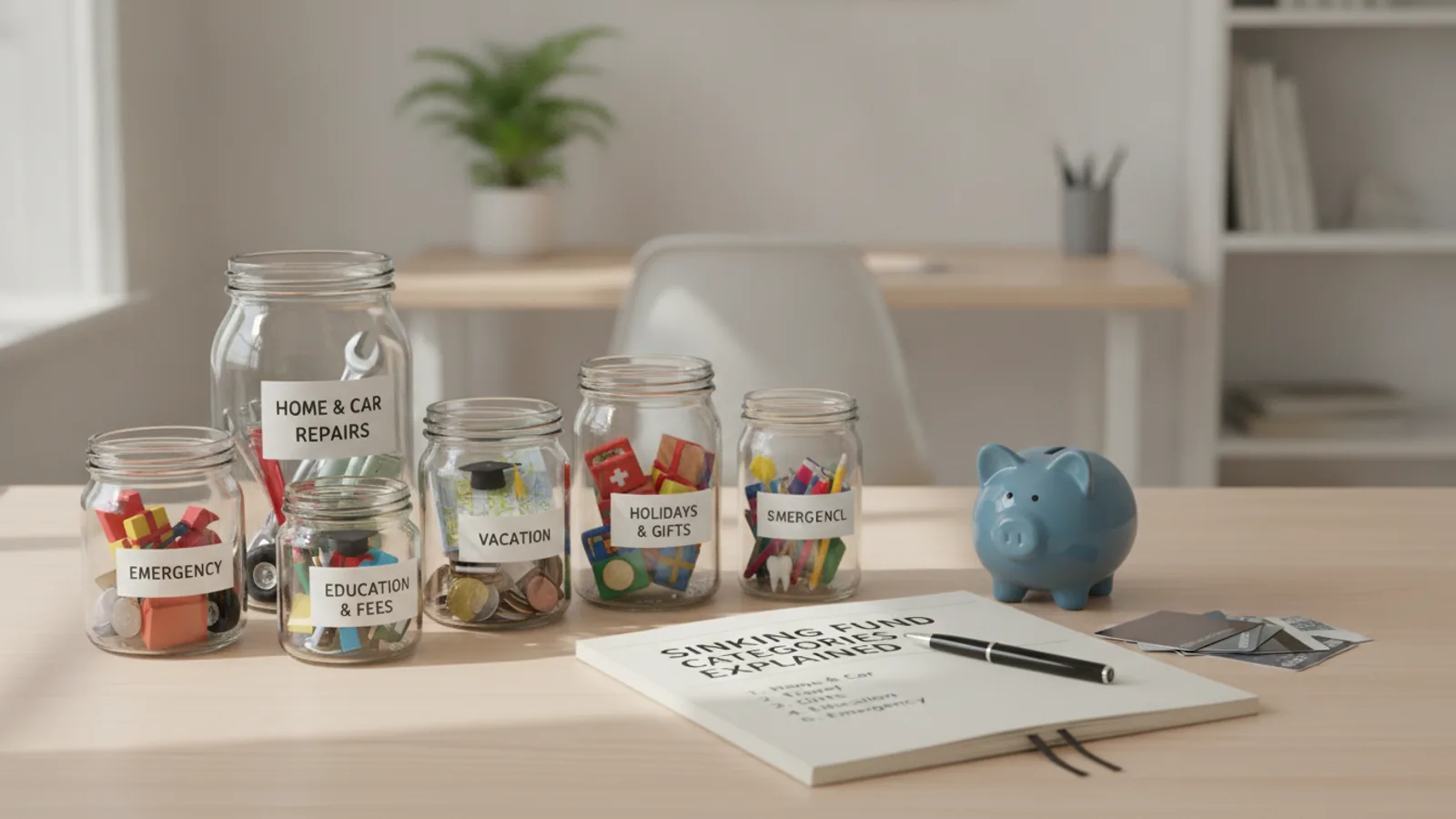
Sinking Fund Categories Explained
A sinking fund is a smart way to save for large, predictable expenses by setting aside a small amount of money each month. This guide explains how to create and organize sinking fund categories so you can pay for big purchases like car repairs, vacations, or holiday gifts without stress or debt. By breaking down your savings goals into clear categories, you can build a powerful system that protects your budget from sudden shocks and helps you reach your financial goals with confidence.
Fast Answer
- Key Concept: A sinking fund is a savings strategy for a specific, planned future expense.
- Key Action: Group similar future expenses into categories (e.g., "Car Care," "Holidays").
- Main Benefit: Avoids debt by ensuring cash is available when large bills come due.
Before You Start
Setting up your sinking fund categories is mostly a planning exercise. The goal is to get a clear picture of your future spending so you can prepare for it. Gather these items to make the process smooth and accurate.
- Your Budget: A record of your monthly income and expenses. If you don't have one, a list of your regular bills and take-home pay will work.
- Financial Goals List: Any big purchases or events you want to save for in the next 1-5 years (e.g., new laptop, vacation, down payment).
- Bank Statements: Looking at the past 12 months can remind you of annual or semi-annual expenses you might have forgotten, like insurance premiums or subscription renewals.
- Calculator, Spreadsheet, or Notebook: You'll need something to do some simple math and jot down your categories and savings targets.
Step-by-Step Instructions
Brainstorm Your Future Expenses
The first step is to identify every significant expense you know is coming that isn't part of your regular monthly bills. Think of this as a financial calendar for the next 12-24 months. Don't worry about the cost yet; just list everything out.
Look through different areas of your life:
- Home: Property taxes, appliance replacement, furniture, new roof, painting.
- Car: New tires, annual registration, insurance premium (if paid annually), major repairs, saving for a down payment on a new car.
- Personal: New phone or computer, vacations, continuing education classes, gym membership renewals.
- Family & Events: Holiday gifts, birthday parties, anniversary trips, weddings (as a guest or for yourself).
- Health: Braces, new glasses or contacts, planned medical procedures, dental work.
- Annual Bills: Professional association dues, credit card annual fees, software subscriptions, Amazon Prime renewal.
Estimate the Cost and Set a Deadline
Now, go through your list and put a realistic dollar amount and a target date next to each item. This gives you a clear goal and a timeline.
For example:
- New Tires: $800 needed by October (8 months from now).
- Holiday Gifts: $500 needed by December (10 months from now).
- Car Insurance Premium: $600 due in June (4 months from now).
- Beach Vacation: $1,500 needed by July of next year (17 months from now).
If you're unsure of the exact cost, do a quick online search to get a reasonable estimate. It's always better to aim slightly high than to come up short.
Calculate Your Monthly Savings Target
This is where the plan comes to life. For each expense, divide the total cost by the number of months you have until the deadline. This simple calculation tells you exactly how much to save each month for that specific goal.
Using our examples from the previous step:
- New Tires: $800 / 8 months = $100 per month.
- Holiday Gifts: $500 / 10 months = $50 per month.
- Car Insurance: $600 / 4 months = $150 per month.
- Beach Vacation: $1,500 / 17 months = $88.24 per month.
The total of these monthly amounts is what you need to add to your budget for sinking funds. In this case, it would be $100 + $50 + $150 + $88.24 = $388.24 per month.
Group Small Goals into Logical Categories
Looking at a long list of individual savings goals can be overwhelming. This is where creating sinking fund categories simplifies everything. Instead of tracking 15 different funds, you can manage just 5 or 6 broader categories.
Combine smaller, related expenses into a single bucket. Here are some popular sinking fund categories:
- Car Care: Combine savings for new tires, oil changes, registration, insurance, and minor repairs into one fund.
- Home Maintenance: A fund for appliance repairs, gutter cleaning, pest control, and saving for a larger project like painting.
- Holidays & Gifts: One category to cover all gift-giving occasions—Christmas, birthdays, anniversaries, etc.
- Vacation: A general travel fund for all your getaway plans.
- Annual Bills: For all those once-a-year subscriptions and fees (Amazon Prime, credit card fees, etc.).
- Personal Tech: To save for your next phone, laptop, or tablet upgrade.
To get your monthly category total, just add up the monthly savings amounts for all the items within that group. For our example, "New Tires" and "Car Insurance" could go into a "Car Care" category, making its monthly contribution $250 ($100 + $150).
Choose a System to Hold and Track Your Funds
You need a place to keep your sinking fund money separate from your regular checking account. If it's all in one place, it's too easy to spend it accidentally. You have several great options:
- Multiple High-Yield Savings Accounts (HYSAs): This is a powerful method. Open a separate HYSA for each major category. This keeps the money physically separate and earns you a bit of interest. You can even nickname the accounts (e.g., "Vacation Fund").
- Savings Buckets or Vaults: Many online banks (like Ally, SoFi, or Capital One) allow you to create digital "buckets," "envelopes," or "vaults" within a single savings account. This is the easiest way to digitally separate your funds without opening multiple accounts.
- Budgeting Apps: Apps like YNAB (You Need A Budget) are built on this concept. You can assign every dollar to a category and track your progress without moving money between accounts. The app does the mental accounting for you.
- Spreadsheets: If you prefer a manual approach, a simple spreadsheet can track how much you've allocated to each category within a single savings account. Just update it every time you contribute or spend from a fund.
Automate Your Contributions
This is the most critical step for success. Don't rely on willpower to move the money each month. Set up automatic transfers from your checking account to your sinking fund accounts (or main savings account) for the day after you get paid. When the money moves before you have a chance to see it or spend it, you guarantee progress.
Set up a recurring transfer for the total monthly sinking fund amount you calculated in Step 3. If you have multiple savings accounts, you can set up a separate transfer for each one. Automation turns saving from a monthly decision into a background habit.
Review and Adjust Your Categories Regularly
Your financial life isn't static, and neither are your sinking funds. Set a calendar reminder to review your categories and goals every 3 to 6 months. During your review, ask yourself a few questions:
- Are these goals still important to me?
- Have the estimated costs changed? (e.g., has the price of that flight gone up?)
- Is my timeline still realistic?
- Do I need to add any new categories for upcoming expenses?
If you get a raise or pay off a debt, you might have more money to allocate. If your car breaks down unexpectedly and you have to use your "Car Care" fund, you'll need to create a plan to build it back up. Regular check-ins keep your sinking fund system relevant and effective.
Quick Reference
| Situation | Use This Category Type | Why It Works |
|---|---|---|
| Saving for a big, one-time event like a wedding or a down payment. | A dedicated, single-purpose fund. | Protects a large, critical goal from being "borrowed" for smaller needs. |
| Handling multiple, small annual bills (e.g., subscriptions, memberships). | A grouped "Annual Bills" category. | Simplifies tracking and prevents the surprise of a forgotten annual charge. |
| Expenses that are predictable but vary in timing and cost (e.g., car repairs, home maintenance). | A general "maintenance" or "repair" fund. | Provides a flexible pool of money for inevitable, but not specifically scheduled, upkeep costs. |
| You have many small, unrelated savings goals. | A flexible "Future Purchase" category. | Acts as a catch-all to save for smaller wants without creating dozens of tiny funds. |
Common Problems When Setting Up Sinking Funds
Even with a great plan, you might run into a few common issues. Here’s how to troubleshoot them.
- Feeling Overwhelmed by Too Many Categories: It's easy to get excited and create 20 different funds. This quickly becomes difficult to manage.
The Fix: Start with just the top 3-5 most important or urgent categories. You can always add more later once you've built the habit. Focus on categories like "Car Care," "Holidays," and "Home Maintenance" first. - "Borrowing" from One Sinking Fund to Pay for Another: You might be tempted to pull money from your "Vacation" fund to cover an unexpected vet bill because the money is just sitting there.
The Fix: This often means your emergency fund is too small or your budget is too tight. First, make sure your emergency fund is healthy. Second, consider creating a small, flexible sinking fund category called "Stuff I Forgot" or "Miscellaneous" to act as a buffer for minor surprise costs. - Falling Behind on Contributions: Sometimes life happens, and you can't afford to contribute the full amount one month.
The Fix: Don't give up! Contribute what you can, even if it's a small amount. Review your budget to see if there are other areas you can trim temporarily to get back on track. You may also need to adjust the timeline or total cost of your goal to make it more realistic. - Forgetting to Spend the Money: It sounds strange, but some people get so good at saving that they feel guilty spending the money they’ve set aside.
The Fix: Remember what the money is for! You did the hard work of saving so you could spend on your goals guilt-free. When the bill comes, pay it from the fund you created and celebrate your successful planning.
Advanced Tips for Sinking Funds
Once you've mastered the basics, these strategies can make your sinking funds even more effective.
- Use High-Yield Savings Accounts (HYSAs): Don't let your sinking fund money sit in a checking account or a low-interest savings account. By using HYSAs, your money can earn competitive interest while it waits, helping you reach your goals slightly faster.
- Create a Sinking Fund "Ladder": For long-term goals (2+ years away), consider putting that money in a low-risk investment like a Certificate of Deposit (CD) to potentially earn a higher return. You can "ladder" CDs with different maturity dates that align with your spending timeline.
- The "Round-Up" Method: Use apps or bank features that automatically round up your debit card purchases to the nearest dollar and transfer the change to a savings account. You can direct these small, painless savings toward one of your sinking fund categories.
- Coordinate with a Partner: If you share finances with a spouse or partner, sit down together to define your sinking fund categories. This ensures you're both aligned on your savings goals and prevents confusion or accidental overspending. Decide who is responsible for tracking and managing the funds.
Sinking Fund Categories Explained FAQ
What's the difference between a sinking fund and an emergency fund?
How many sinking fund categories should I have?
Where is the best place to keep sinking fund money?
Can I use cash envelopes for my sinking funds?
What if I don't have enough money in my budget to start all the funds I want?
Final Checklist for Sinking Fund Categories
Use this final checklist to make sure your sinking fund system is ready to go.
- I have brainstormed all my significant, non-monthly expenses for the next 1-2 years.
- I have assigned a realistic cost estimate and a target date to each expense.
- I have calculated the required monthly savings amount for each goal.
- I have grouped smaller, related goals into logical, easy-to-manage categories.
- I have chosen a system to hold my money (e.g., HYSAs, savings buckets, app) and keep it separate from my checking account.
- I have set up automatic, recurring transfers to fund my sinking funds each payday.
- I have scheduled a reminder in my calendar to review and adjust my funds in 3-6 months.